



Challenge
Aevum began as an idea from Techelp2u, an IT services company tired of paying for popular but expensive tools that each held one slice of their operations. The replacement needed to make the handoff from work performed to money owed visible without turning every screen into an accounting tool.
Approach
The data model came first. If clients, tasks, time, and money are not connected records underneath, no dashboard can fix it.
- Modeled the core operating objects first: clients, tasks, time logs, retainers, invoices, team members, roles, and organization settings.
- Built a dashboard that summarizes time, billable amount, invoice status, retainer usage, client activity, and recent operational movement.
- Connected client work to billing evidence by linking tasks, time logs, retainer allocation, invoice line items, and invoice status actions.
- Created a seeded demo workspace so the product can be reviewed safely with realistic data instead of live customer records.
Workflow model
The important product decision was to model agency operations as connected records instead of isolated pages. A client is not just a contact, a task is not just a to-do, and a time log is not just a row in a spreadsheet. Each one needs enough structure to support billing later.
- Client records hold contact, billing, task, time, invoice, and retainer context.
- Tasks carry status, priority, assignee, client, and date fields.
- Time logs preserve user, duration, description, billable state, and allocation status.
- Retainers and invoices expose the commercial state of the work without burying it in settings.
Operational dashboard
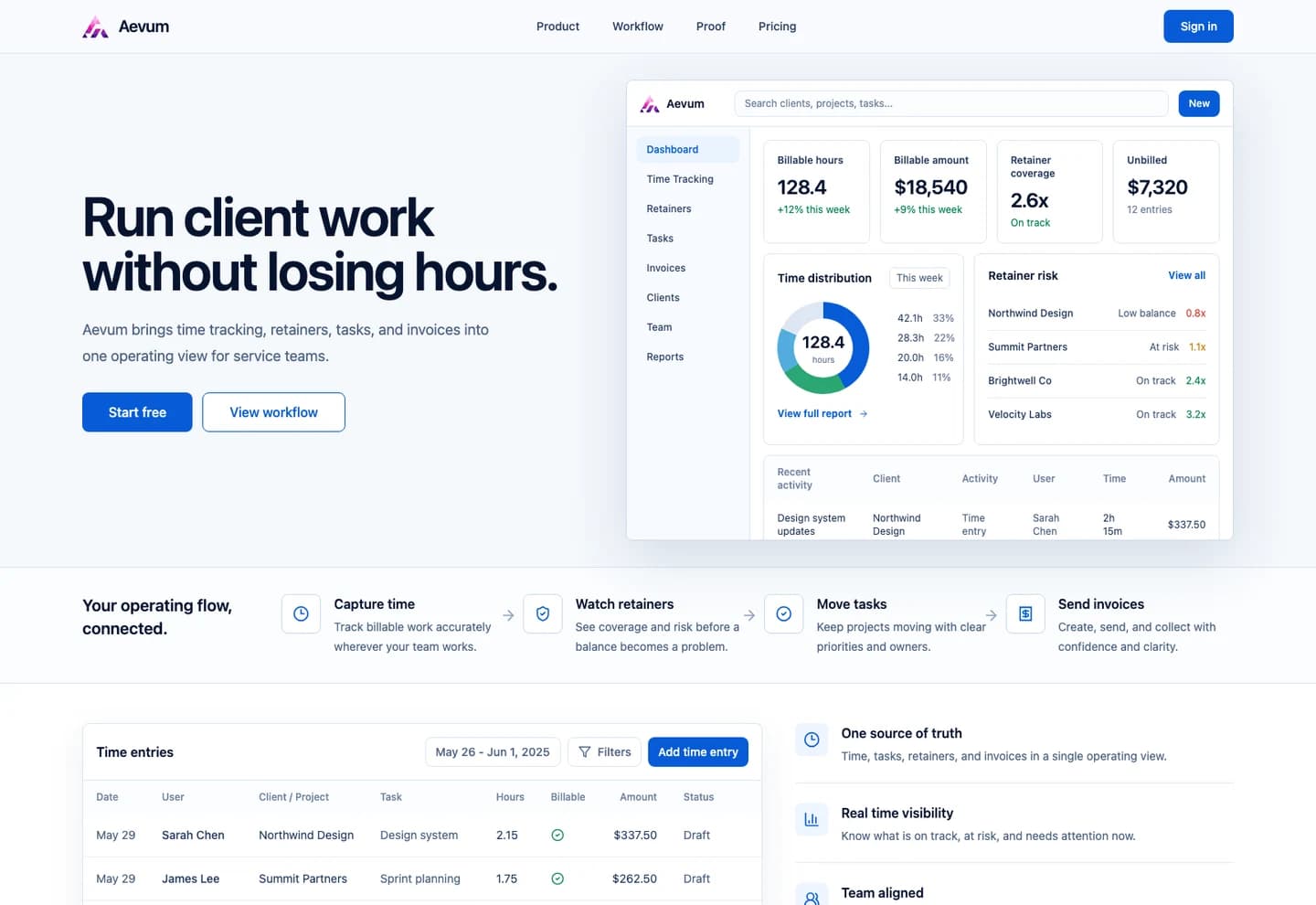
The dashboard is the best proof of the system because it pulls the operating model together. Time totals, billable totals, quick actions, client activity, time distribution, invoices, retainers, tasks, and recent activity can all be understood without navigating through every module first.
- Summary cards show total time, billable time, billable amount, and entry count.
- Charts separate client activity from billable versus non-billable time.
- Invoice and retainer summaries keep finance state visible to operators.
Billing workflow
Aevum treats billing as an operating workflow rather than a final export. Retainers, time logs, and invoices each have their own surfaces, but the screens are designed to make the handoff between them understandable.
- Retainer records show client, monthly allocation, status, and usage.
- Invoice detail includes client billing information, line items, tax, total, notes, and status actions.
- Export, print, payment status, and accounting-sync actions are visible at the point of review.